
Problem → Solution: How to create an inventory of all resources you have to make a film
On micro-budget films, resources live in people’s heads instead of on paper.

Problem: On micro-budget films, resources don’t live on paper.
Solution: Write a Resource Filmmaking Inventory before locking the production plan. (Example)
Dear Reader,
Most micro-budget films don’t fail because they’re underfunded.
They fail because the resources were never clearly inventoried.
This is a quiet problem I ran into while developing Burying Doris—and the production system I now use to prevent it.
The Problem
Problem:
On micro-budget films, resources live in people’s heads instead of on paper.
Locations are assumed.
Props are “probably available.”
Equipment is “somewhere.”
That vagueness leads to:
Last-minute rentals
Unplanned purchases
Crew confusion
Creative compromises that feel avoidable in hindsight
I realized that even though Burying Doris was now designed to be a resource-driven film, I didn’t actually have a single document proving that reality.
The Solution
Solution:
I created a Resource Filmmaking Inventory before locking the production plan.
This inventory does one simple thing:
It lists everything the movie touches—and confirms whether it already exists, needs to be built, borrowed, rented, or cut.
Instead of starting from “What do we need to buy?”
It starts from “What do we already have access to?”
That shift alone reframed the entire production.
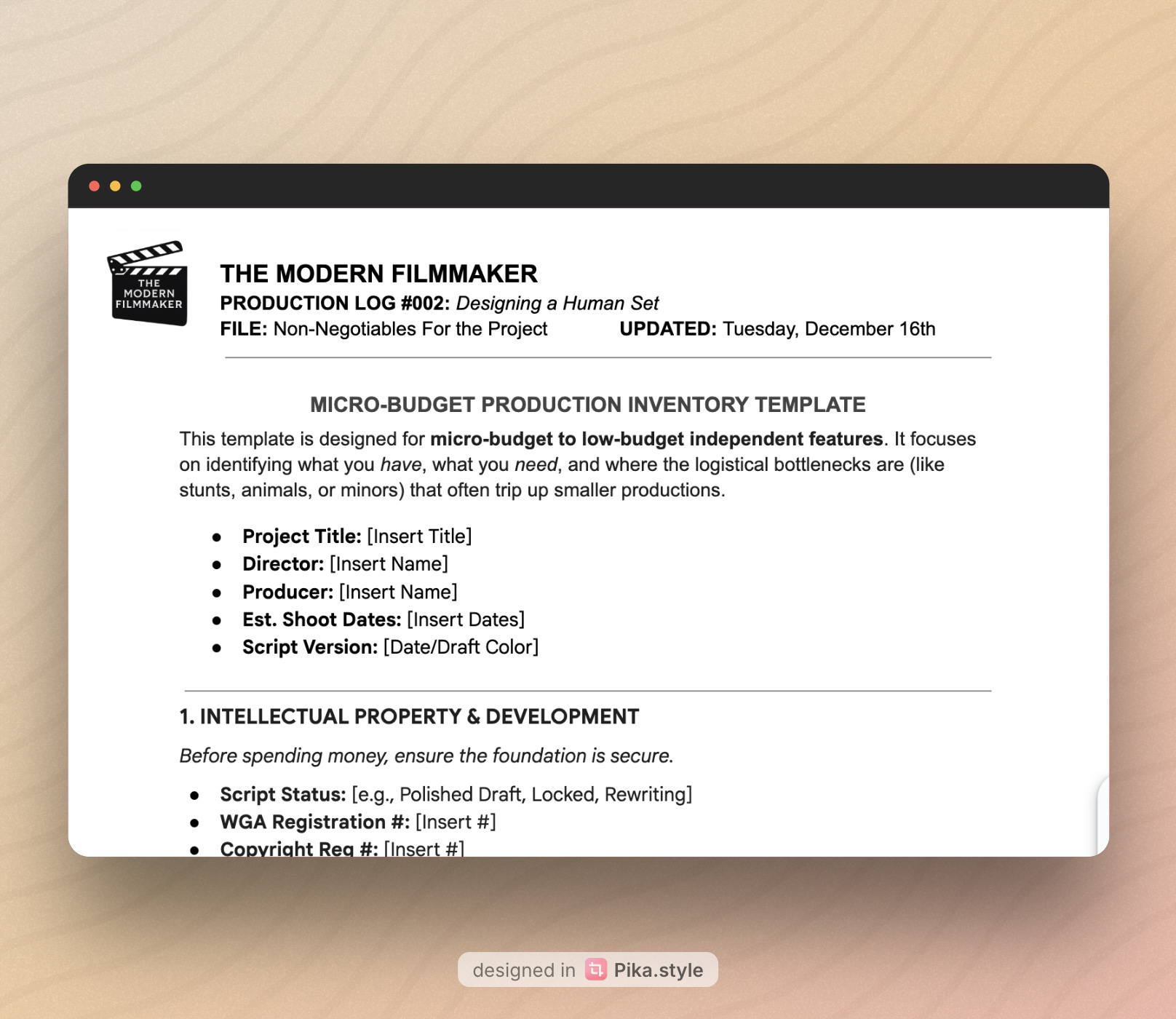
How the Inventory Works
The inventory is broken into practical, production-facing sections:
Intellectual Property & Development
Ensures the legal and creative foundation is secure before money is spent.Locations
Prioritizes owned or freely accessible spaces and identifies logistical needs early.Cast & Talent
Clarifies speaking roles, union considerations, and scheduling risks.Art Department & Props
Separates hero props from environmental dressing so nothing critical is missed.Wardrobe, Vehicles, Animals
Often-overlooked cost centers that quietly add up.Production Equipment
Clearly defines what’s owned vs. rented vs. borrowed.Special Effects & Safety
Flags high-risk elements before they become insurance or liability issues.Post-Production Resources
Locks in the finishing path early instead of hoping it works out later.
Once completed, the inventory becomes the backbone of:
Budgeting
Scheduling
Creative decision-making
Investor conversations
A Real Example: Burying Doris
When I built the inventory for Burying Doris, something clicked.
Almost every major location already existed on our farm.
The cast size was manageable.
The props were specific—but achievable.
Instead of guessing whether the film was “possible,”
I could prove it.
The inventory didn’t just organize the project—it validated it.
The Resource
👉 Micro-Budget Production Inventory Template (LINK)
This is the exact framework I use to:
Stress-test a script against real-world resources
Identify hidden costs before they appear
Build films around what already exists
You can adapt it for:
Feature films
Shorts
Proofs of concept
Any resource-driven creative project
Final Thought
Micro-budget filmmaking isn’t about having less.
It’s about knowing exactly what you have.
An inventory doesn’t limit creativity.
It protects it.
We can do it.
Together, with faith.

— M.P. Rekola
P.S. How I Sustain the Work
I’m an independent creator. I don’t have a studio overhead or trust fund backing this work. I earn my living through:
Affiliate links, views, and one-time donations (click here).
Sales of The Modern Filmmaker’s On-Set Filmmaking Dictionary on Amazon
Producing industrial and commercial work through Goodworks (you can hire us)
Consulting on individual projects
And a micro drive-in movie theatre, I’m currently building
None of this is separate from the art.
It’s what allows the art to keep happening.
Reach out if you have an opportunity.
Reminder— advice & networking are always free.